
Skip to content
Book a Demo

The attribution gap

Your tracking is broken. Here’s why.

Your tracking depends on data surviving advertising platforms, apps, browsers, consent, cookies and third-party systems. Information gets lost along the way, leaving you with incomplete analytics and only part of the picture.

See where tracking fails

The Blind Spot

One in four visitors has no known source.

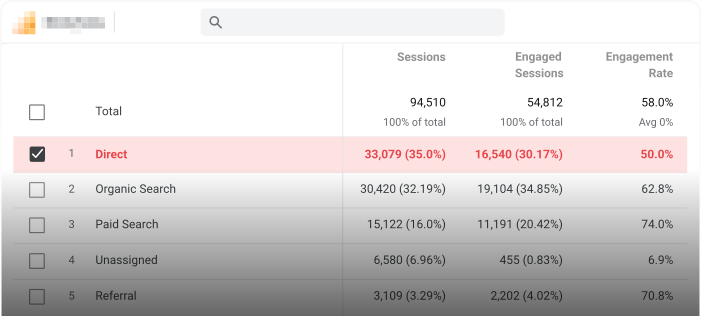
This figure is the average we’ve seen across new agency-managed accounts since early 2020s. Missing visits don’t all vanish from the dashboard, they often get reassigned to “Direct”.

Example GA4 traffic report with Direct traffic highlighted.

The default answer

Direct is partly a channel, but mostly a fallback.

Despite the name, Direct is rarely people who typed-in your address. It’s often where analytics puts visits it couldn’t identify. The size of the number is not brand awareness, it’s what the tracking is losing. High ad spend and a large Direct numbers travel together, as paid traffic is most vulnerable to having its source stripped.

Chart comparing unknown Direct traffic with Reddit, Google Ads and Facebook traffic.

Where tracking breaks

The 4 common points of tracking failure.

Attribution does not usually break in one dramatic moment. It erodes across the path from campaign click to business outcome.

01

The source is lost

The source never reaches your analytics intact.

Campaign parameters may be stripped, shortened links may hide the referring page, and privacy-focused browsers can reduce referrer detail. Analytics receives the visit but not the reliable context behind it.

02

The visit is partly recorded

The page loads, but tracking does not behave as expected.

Scripts can be blocked, delayed or prevented from firing. Consent settings and tag configuration can also produce gaps. The customer arrived; the analytics record may be partial or absent.

03

The session is split

One visit becomes several disconnected records.

Moving between domains, payment platforms or booking tools can restart sessions and overwrite attribution. Instead of one coherent path, the report shows fragments that are difficult to reconnect.

04

The outcome loses its source

The result is recorded without the marketing context.

A quote request, booking or purchase may still appear, but its original source has been replaced or removed. Revenue exists; confidence about what produced it does not.

Uneven exposure

Some channels lose more than others.

Paid social, email, affiliates, QR codes and links opened inside apps are more exposed to source loss than a straightforward browser search. The reporting bias is not evenly distributed, so channel comparisons can become misleading.

Comparison charts showing that source loss affects channels unevenly.

The consequence

Missing data becomes misplaced confidence.

Dashboards can calculate perfectly from incomplete inputs. That precision creates false confidence: teams move budget, judge campaigns and forecast growth using categories that may describe a tracking failure rather than customer behaviour.

Paid channels look weaker

Source loss removes credit from the campaigns that generated the visit.

Direct looks stronger

Unknown arrivals are absorbed into a category that appears intentional.

Journeys look shorter

Fragmented sessions hide the actions that happened before the outcome.

Budget follows noise

Clean-looking reports reward whichever channels retained the most evidence.

Why the gap persists

A new report cannot recover a missing source.

Better tags, models and dashboards can help, but they can’t recreate source details that were never recorded.

Typical fix What it helps with What it cannot restore
Add more UTMs Creates clearer labels when parameters survive. A parameter removed before capture.
Change attribution models Redistributes credit across the data available. Missing evidence or disconnected sessions.
Build another dashboard Makes existing information easier to inspect. The source that never entered the dataset.
Move tags server-side Can improve control over event delivery. Origin information already lost on arrival.

A more reliable approach

Know the source. Follow the session. See the outcome.

Dáva captures where each visit came from before the source can be stripped or misclassified. It then connects that source to every page visited, event recorded and outcome reached within the same session.

See how Dáva works
Illustrative session showing a campaign click, landing page, product page, pricing page, quote request and enquiry sent.

The layer most companies skip

Reliable capture still needs consistent meaning.

Many companies don’t have one agreed system for naming campaigns, classifying sources or defining meaningful outcomes. Dáva’s governance layer solves this by creating a shared tracking language while preserving the original evidence.

Explore tracking governance

Common questions.

Direct is used when the platform cannot identify another source. It includes genuine direct visits, but it can also contain traffic whose referrer or campaign parameters were removed before the visit was classified.

UTMs improve consistency when they survive. They do not solve the underlying problem when parameters are stripped, links are copied, redirects remove context or sessions restart across domains.

Server-side tracking can improve control over data collection and event delivery. It cannot recreate source information that was already missing before the server received the visit.

No. Unknown traffic can come from many sources. The goal is not to force every visit into a marketing channel. It is to separate verified sources, genuine Direct activity and traffic whose origin remains unknown.

See what happens between the click and the outcome.

See how Dáva can show you what’s working, what isn’t and where your money should go next.

Book a Demo 30 minutes | Live data walk-through